
Operational works · Sunshine Coast
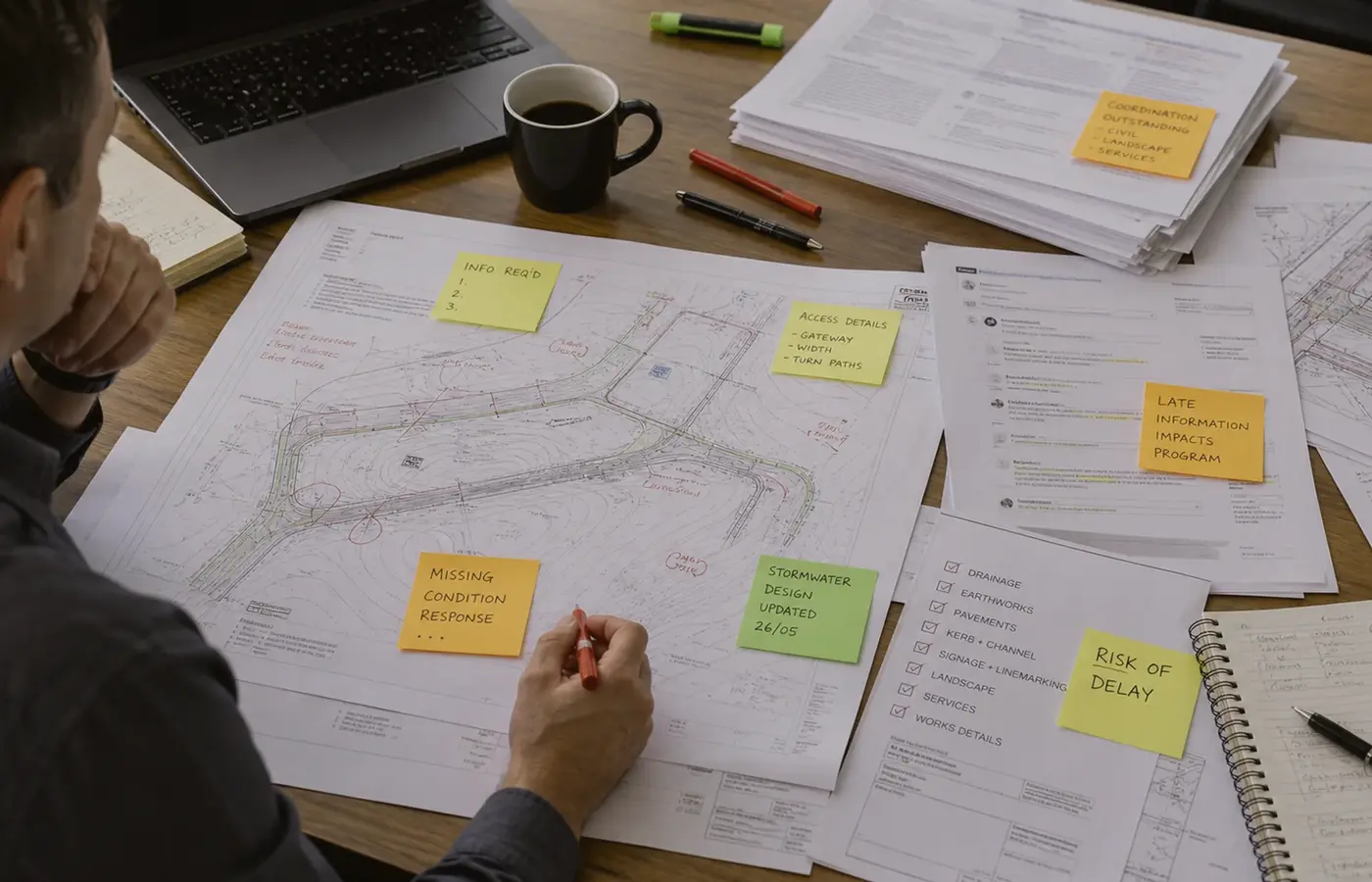
Operational works information requests: civil triggers that cause delays on Sunshine Coast projects
The civil issues that commonly drive operational works information requests, with a risk register and brief checklist for Sunshine Coast developers.
Concept illustration
Project question?
Check the civil constraints before committing to your next step.
Send CivilCity the address, current plans, approval stage and the issue you are trying to resolve. We will help scope the right civil engineering input for the project.
Quick answer
Operational works information requests usually happen when the submitted package does not give Council enough evidence to understand, assess or condition the proposed civil works. On Sunshine Coast projects, the high-risk gaps are stormwater discharge, levels, driveway grades, frontage works, service conflicts, retaining interfaces and missing survey.
A fast lodgement is not useful if the unresolved issue could change the design. The commercial question is which missing items can be closed now, which can be carried with clear assumptions and which should stop lodgement until the design is better supported.
Local Sunshine Coast context
Sunshine Coast operational works applications are assessed against the approval, relevant codes, current Council guidance and the supplied design evidence. For development teams, that means the civil drawings need to explain the proposal clearly enough for assessment and later construction, not merely satisfy a document checklist.
Local sites often combine drainage, access and earthworks constraints. A driveway long section may depend on frontage levels; a stormwater outlet may depend on downstream levels; retaining can affect boundaries, access and overland flow. Those interactions are where avoidable information requests tend to appear.
Information request risk register
Review these triggers before operational works lodgement.
| Trigger | Evidence to prepare | Delay mechanism |
|---|---|---|
| Stormwater outlet unclear | Discharge path, levels, calculations and receiving system information | Council cannot assess whether the drainage arrangement is workable |
| Access grades unresolved | Long section, tie-in levels, turning and clearance checks | Driveway or frontage details may need redesign |
| Survey missing or too narrow | Current feature survey with off-site ties where relevant | Design assumptions cannot be verified |
| Conditions not cross-referenced | Condition register linking drawings, notes and reports | Assessor has to ask where each requirement is addressed |
| Services not coordinated | Known service locations, easements and authority advice | Civil works may clash with assets or maintenance access |
Example: the avoidable request
Consider a townhouse access and stormwater package lodged from an old concept survey. The drawings show a driveway grade and pipe outlet, but the frontage levels and downstream invert are not confirmed. Council asks for more information because the design relies on levels that are not evidenced.
The better sequence is to identify those controlling levels before lodgement, update the drawing set and explain the condition response. That does not guarantee no questions, but it prevents a predictable gap from becoming a programme delay.
Common mistakes
The first mistake is answering each drawing comment in isolation. A stormwater comment may change earthworks; an access comment may change retaining; a service clash may alter the layout. Treat the request as a design coordination exercise, not a paperwork exercise.
The second mistake is using vague responses such as 'to be confirmed during construction' for issues that control approval. Some construction details can be finalised later, but approval-critical levels, discharge paths and interfaces need enough evidence for assessment.
Checklist for your project brief
Use this checklist before lodging or responding to an information request.
- Build a condition and comment register with owners and due dates.
- Confirm the current drawing revision and remove superseded assumptions.
- Check stormwater outlet, lawful discharge basis and downstream constraints.
- Review driveway grades, frontage tie-ins and swept paths where relevant.
- Reconcile civil drawings with survey, landscape, architectural and service inputs.
- Separate approval-critical answers from details that can be documented for construction.
- Keep a clean response trail showing what changed and why.
When CivilCity should be involved
Involve CivilCity before operational works lodgement if the design depends on unresolved levels, discharge, access or service information. If an information request has already arrived, send the full request, submitted drawings, approval and consultant documents so the response can be scoped properly.
CivilCity's role is to identify the technical cause of the delay, coordinate the civil response and help the team submit clearer evidence for the next assessment step.
Common questions
Can an information request always be avoided?
No. Some requests arise because Council or a referral agency needs more evidence. The goal is to remove avoidable gaps before lodgement and make any remaining questions specific and answerable.
What civil issues most often create delay risk?
Stormwater discharge, access grades, frontage tie-ins, earthworks, retaining interfaces, service clashes, missing survey and unclear condition responses are common delay triggers.
Should I lodge quickly and answer questions later?
That can work for some projects, but it is risky when the missing information could change the design. If the unresolved item controls layout, levels or discharge, answer it before lodgement.
What does CivilCity need to review delay risk?
Provide the approval, conditions, current drawings, survey, stormwater assumptions, service information and any previous Council correspondence.
Official sources and further guidance
- Sunshine Coast Council: operational work
- Sunshine Coast Council: development application forms
- Sunshine Coast flooding and stormwater management guidelines
Use the current requirements for your property and proposal. Illustrative scenarios describe possible design issues; they are not reported client projects.
Discuss your project
Review operational works delay risk before lodgement
Send CivilCity the approval, drawings and survey so avoidable civil information-request triggers can be found early.