
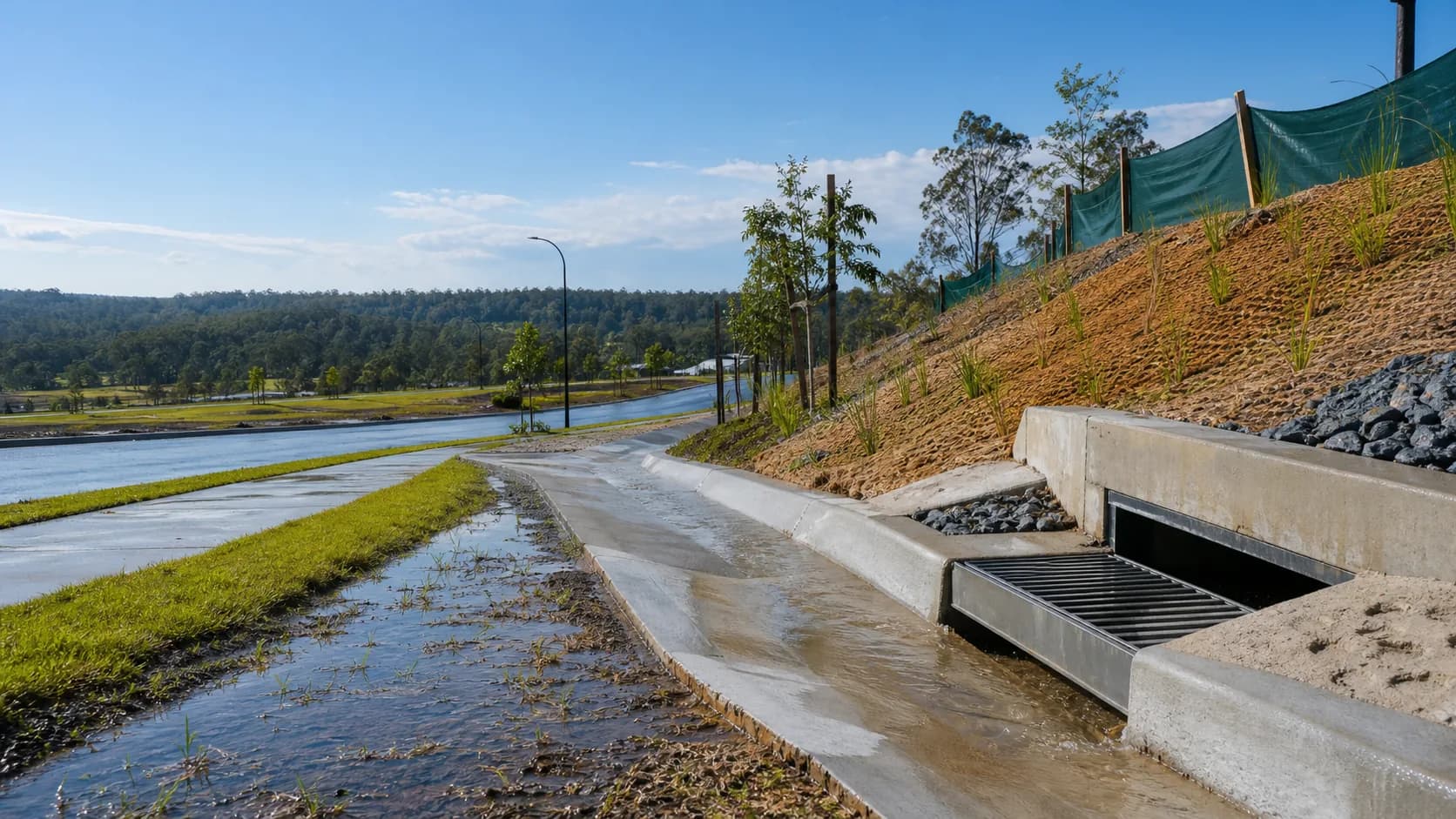
Stormwater - 23 September 2026
Stormwater engineer Sunshine Coast: when development needs drainage advice
When to involve a stormwater engineer on Sunshine Coast development sites, including lawful discharge, detention, overland flow, levels and approval risk.
Quick answer
A Sunshine Coast stormwater engineer helps test where water will go, whether the discharge route is lawful and practical, and what drainage works are needed for a development to be approved, built and maintained.
Get stormwater advice early when a project depends on subdivision yield, new buildings, driveway grades, filling, retaining, detention, overland flow paths or a tight downstream outlet. Stormwater is not a tidy detail at the end; it can decide the layout.
The stormwater checks that matter
A good drainage review joins levels, catchments, infrastructure and approval requirements. The engineer should test the existing flow path, proposed finished levels, roofwater, surface runoff, discharge point, easements, downstream impacts and whether treatment or detention is likely.
This is especially important on infill sites, rear lots, sloping blocks and townhouse or commercial projects where more hardstand area can change the way water moves across the site.
| Stormwater issue | Evidence to check | Common commercial risk |
|---|---|---|
| Lawful discharge | Outlet location, levels, ownership and approval pathway | The site may need an easement or redesign. |
| Overland flow | Council mapping, survey levels and visible flow routes | Buildings or access may sit in the wrong place. |
| Detention | Catchment, impervious area and downstream constraints | Storage can consume valuable developable area. |
| Water quality | Treatment requirements and maintenance access | Small sites can run out of room for practical devices. |
Why Sunshine Coast sites need local judgement
Coastal infill, older urban areas, hinterland slopes, low-lying land and greenfield edges create different drainage problems. Some sites have formal stormwater infrastructure. Others rely on overland routes, table drains, gullies, easements or downstream private land.
Council information, mapping and nearby approvals are useful starting points, but the real answer comes from the project survey, site levels, discharge route, development footprint and proposed civil design.
Mistakes that delay approvals
The most common mistake is assuming stormwater can be solved after the planner or architect has locked the concept. If the outlet is too high, the downstream route is unavailable or detention takes too much space, the layout may need to change.
Other mistakes include ignoring tailwater, placing buildings across overland flow paths, forgetting maintenance access, underestimating water quality treatment, and treating roofwater separately from the full site grading strategy.
When CivilCity should be involved
Send CivilCity the address, survey if available, concept plan, known drainage assets, approval stage and the decision you need to make. For purchase due diligence, the key output may be a short drainage risk note. For approval or construction, the output may be a stormwater strategy, drawings or calculations.
CivilCity can support stormwater feasibility, drainage layouts, detention and treatment coordination, lawful discharge checks, operational works documentation and responses to approval conditions.
FAQ
Common question
When should I contact a stormwater engineer?
Contact a stormwater engineer before the layout is fixed if the site has slope, flood or overland flow risk, uncertain discharge, downstream constraints, a new lot layout or a development application that changes hardstand or roof area.
Is a nearby pit always a lawful point of discharge?
No. A visible pit or drain is not automatically an accepted connection point. The levels, asset ownership, capacity, approval pathway and discharge rights still need to be checked.
Does every site need detention?
Not every site, but detention or other controls may be needed depending on the development, catchment, downstream conditions, council requirements and approval conditions.
Can stormwater change subdivision yield?
Yes. Drainage routes, easements, detention areas and levels can change lot layout, building envelopes, retaining and the number of lots that remain commercially practical.
Useful official resources
Need project-specific civil advice?
Send CivilCity the project location, approval stage and the issue you need resolved.
Contact CivilCity