
Due diligence · Sunshine Coast
What a civil due diligence report should include for a subdivision site
A buyer's guide to the evidence, assumptions, options, limitations and next actions that make a subdivision civil due diligence report useful.
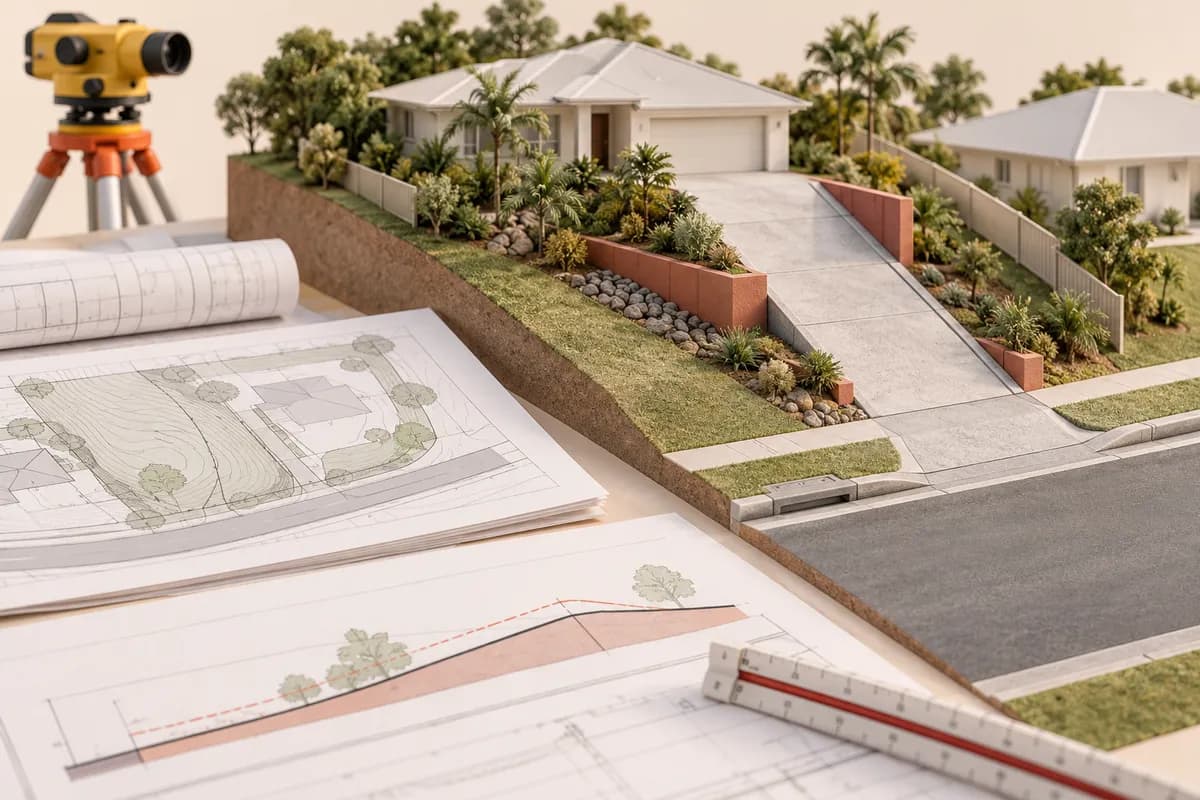
Concept illustration
Project question?
Check the civil constraints before committing to your next step.
Send CivilCity the address, current plans, approval stage and the issue you are trying to resolve. We will help scope the right civil engineering input for the project.
Quick answer
A useful civil due diligence report for a subdivision site should define the proposal assessed, list the evidence reviewed, distinguish facts from assumptions, map the constraints, explain their consequences, compare realistic options and identify the next investigation or decision. It should cover access, levels, stormwater, services, earthworks, retaining, easements and construction dependencies at a proportionate level.
The report is valuable because it protects a decision, not because it has a particular page count. A buyer should be able to see what is known, what is uncertain, what could change the outcome and which specialist or authority needs to answer the remaining question.
Start with the decision the report must support
The report brief should state whether the buyer is testing a two-lot concept, a rear lot, a townhouse layout, a staged subdivision or another outcome. Include the target yield, existing buildings, access preference, contract deadline and minimum acceptable result.
That specificity matters on the Sunshine Coast because coastal infill, sloping hinterland land, established suburbs and developing areas present different combinations of access, drainage, servicing and earthworks constraints. Council's planning scheme and Development.i information can frame the review, but they cannot answer every physical or authority question.
Report contents and decision value
Use this as a quality check when reviewing a proposal or deliverable.
| Report element | What good looks like | Decision it supports |
|---|---|---|
| Defined brief | Proposal, drawing revision, target outcome and deadline | Everyone reviews the same development assumption |
| Evidence register | Source, date, author, reliability and missing information | A buyer can distinguish fact from inference |
| Constraint plan | Access, drainage, services, levels, earthworks and easements tied to the site | The risk is located rather than described generically |
| Options and trade-offs | At least the realistic alternatives and dependencies | The buyer can compare a change in layout or scope |
| Risk and assumptions register | Consequence, owner, investigation and trigger | Uncertainty can be managed in the contract and programme |
| Limitations and next actions | What the review cannot establish and what should happen next | The report is not over-relied on as approval or detailed design |
Evidence should be connected to consequences
A title search can identify registered interests, but it does not establish that a proposed pipe or driveway fits within an easement. A utility record can point to an asset, but it does not by itself prove capacity, depth or a connection arrangement. A contour survey can show levels, but not ground conditions. The report should name the limit of each source.
For each material constraint, ask what it changes: lot yield, building envelope, access, drainage, external works, approval pathway, construction sequence or the need for another consultant. This is where a report becomes a decision tool rather than a document repository.
Example: a report that prevents false precision
Consider an illustrative subdivision site where the concept shows two lots and a shared driveway. The available survey covers the property but not the road tie-in or downstream drainage asset. The report can still identify a likely access and drainage dependency, compare the known layout options and specify the survey information needed next.
It should not convert the missing evidence into an exact grade, a guaranteed discharge route or a promised lot outcome. The honest conclusion may be that the concept is worth further testing subject to two defined investigations. That is more useful than a confident-looking plan built on invented certainty. This is an illustrative example, not a client result.
What the report should not promise
A civil due diligence report should not promise approval, title registration, a fixed cost, a guaranteed yield or technical certification unless the relevant evidence and scope genuinely support that statement. It should not replace planning, legal, geotechnical, survey, utility or financial advice.
It should also avoid burying exclusions. If a site visit was limited, services were not located, flood behaviour was not modelled or authority advice was not obtained, say so near the relevant conclusion and define the action that would reduce the uncertainty.
Checklist for your project brief
Ask for these items in the brief or deliverable where they are relevant to the decision.
- The development outcome and drawing revision assessed.
- Documents reviewed, source dates, site observations and key evidence limits.
- Access, levels, drainage, services, earthworks, retaining and easement constraints linked to the concept.
- A table connecting each risk to its consequence, evidence gap, responsible party and next action.
- Options considered and the reason one path is preferred or held pending investigation.
- A clear limitation statement and decision-ready conclusion, including what would change it.
Common mistakes
A report fails when it repeats a service brochure, lists every possible constraint without ranking them, or gives a yield without stating the concept and assumptions. It also fails when the team treats a desktop report as detailed design or sends a different plan to the planner, surveyor and engineer.
Do not judge the report by how reassuring it sounds. Judge it by whether you can identify the next evidence, the person responsible and the decision that follows each material risk.
When to involve CivilCity
Involve CivilCity when you need a proportionate engineering decision record before buying land, fixing a subdivision layout or commissioning detailed design. CivilCity can scope the review around the proposal, evidence and deadline rather than issuing a generic site summary.
Common questions
Is a civil due diligence report the same as detailed design?
No. Due diligence tests a decision and identifies constraints, evidence gaps and next steps. Detailed design develops the selected solution to the level required for approval, construction or certification.
Should the report include a subdivision yield?
It can assess the stated concept and identify constraints affecting yield, but any preliminary outcome must be labelled with its assumptions and limits. It is not a guaranteed approval or title outcome.
What makes a report actionable?
It connects each material constraint to evidence, consequence, alternative or investigation. A list of generic risks without a decision path is less useful than a shorter, site-specific register.
Official sources and further guidance
- Sunshine Coast Council: Development.i site report
- Sunshine Coast Planning Scheme 2014
- Sunshine Coast Council: development applications
- Unitywater: subdivisions
Use the current requirements for your property and proposal. Illustrative scenarios describe possible design issues; they are not reported client projects.
Discuss your project
Scope a decision-ready site review
Send CivilCity the concept, site documents and decision deadline so the report answers the risks that can actually change your subdivision decision.