
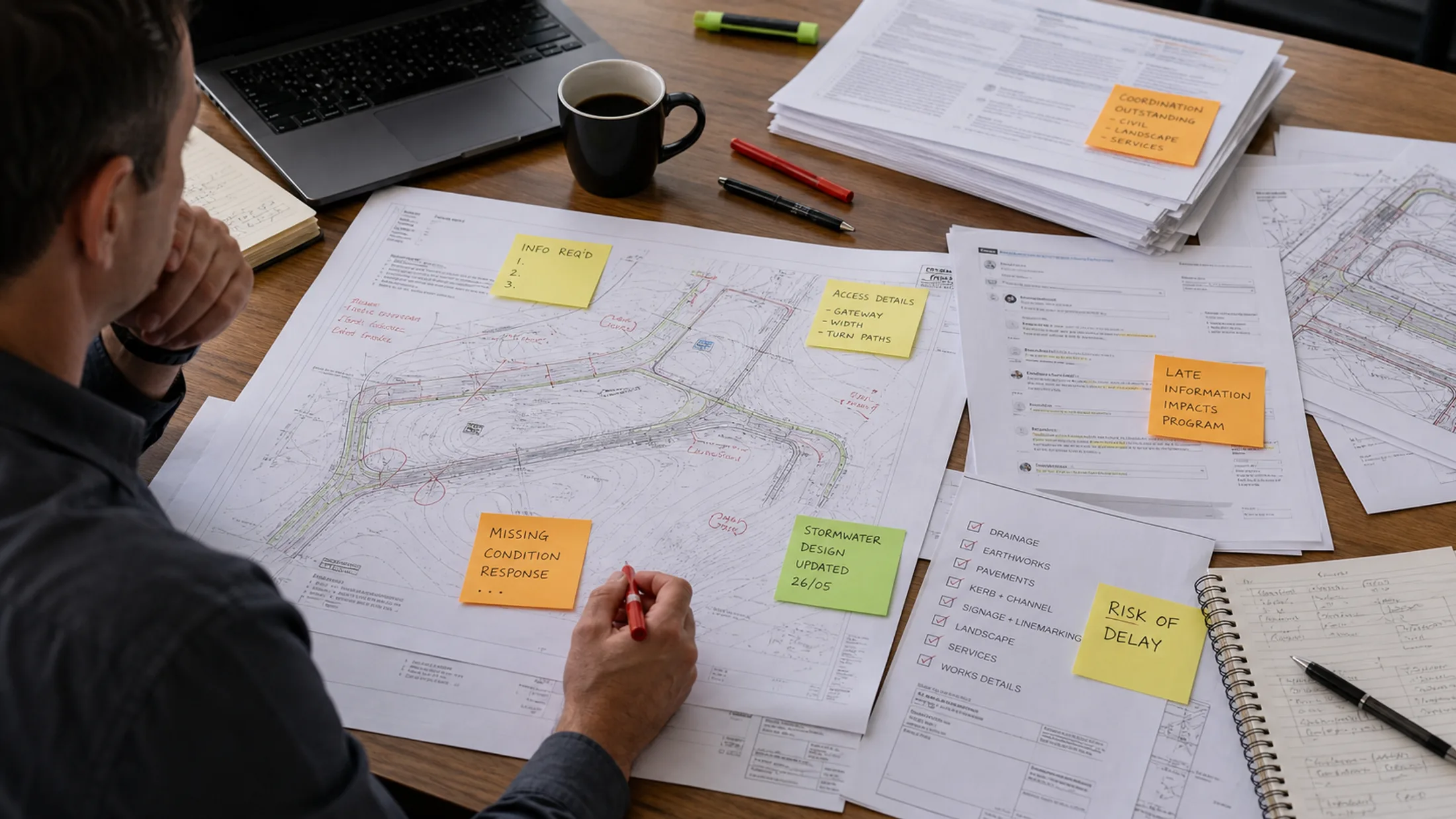
Operational works · Sunshine Coast
Why plan sealing gets delayed on the Sunshine Coast and how to avoid it
A practical Sunshine Coast subdivision closeout guide covering civil works, evidence, as-constructed records, conditions and common plan-sealing delays.
Quick answer
Plan sealing on the Sunshine Coast is delayed when the project team cannot demonstrate that the subdivision conditions and required infrastructure have been completed, inspected and documented. The usual causes are unfinished or non-compliant civil works, missing as-constructed survey information, unresolved variations, outstanding service authority items, incomplete certificates or a plan that does not match the constructed site.
The fix is to treat plan sealing as a project deliverable from the start. Build a condition register, define the evidence required for each item, put survey and inspection hold points into the construction programme, and reconcile the final civil package before the application is submitted.
Why a finished-looking site may not be ready
A driveway, drainage system or retaining wall can look complete while the closeout file is incomplete. Buried pipes may not have been surveyed before backfill; a pit may have moved around an existing service; a level may differ from the approved design; or a contractor may have changed materials without recording the change.
Council's plan-sealing process must be assessed against the specific approval, conditions and current forms. A visual inspection alone does not replace the technical, cadastral, service and certification evidence needed to show what was approved and what was built.
The closeout risk register
Use the following as a pre-submission review. The exact requirements depend on the development approval and works, so confirm them with Council and the project consultants.
| Risk area | Evidence to check | Typical delay trigger |
|---|---|---|
| Civil conditions | Condition register, approved drawings and completion records | A condition is marked complete without supporting evidence |
| Stormwater and access | Final levels, inspections, tests and connection records | Constructed grades or discharge differ from the design |
| As-constructed information | Surveyed assets, inverts, dimensions and marked variations | Design drawings are submitted as if they record the built work |
| Services and authorities | Connection approvals, certificates and acceptance records | Utility or contributed-asset item remains unresolved |
| Cadastral closeout | Surveyor's plan, boundaries and required supporting documents | The cadastral plan and civil records do not align |
A practical Sunshine Coast example
Consider a two-lot subdivision in Buderim with a shared driveway, a stormwater connection and a short retaining edge. During construction, an existing service forces the stormwater pit to move and the driveway transition to change. The works may still be acceptable, but the team needs to assess the change, obtain approval where required, survey the installed assets, update the civil records and retain inspection evidence.
If the change is discovered only when plan sealing is due, the project may need a return survey, exposure of buried infrastructure, revised calculations, a condition response or contractor attendance. That is avoidable closeout cost caused by late evidence, not by the original design alone.
How to prevent the usual delays
1. Read the decision notice, conditions, approved plans and current Council plan-sealing information before tender. 2. Convert every condition into an owner, deliverable and evidence item. 3. Add survey pickup before backfill for buried drainage, services and critical levels. 4. Record site changes immediately and have the civil engineer assess whether a formal variation is needed. 5. Collect inspections, tests, photos, certificates and authority sign-offs as the work progresses. 6. Reconcile the as-constructed package against the approved plans and the cadastral survey. 7. Run an outstanding-items review before requesting completion or plan sealing.
Mistakes that cost time and money
The first mistake is leaving closeout to the end. The second is assuming a contractor's red-line markup is a surveyed as-constructed record. The third is treating minor field changes as informal when they alter levels, drainage, access or infrastructure. Other common problems include missing inspection records, inconsistent lot numbers, unresolved bonds, unconfirmed service connections and a plan-sealing request based on an old approval or superseded drawing.
These failures create avoidable holding costs and can require consultants or contractors to revisit a site after equipment has left. They also make it harder to distinguish a genuine construction defect from a documentation gap.
When CivilCity should be involved
Bring CivilCity in before construction if the approval includes new stormwater, shared access, retaining, frontage works, service connections or other conditioned infrastructure. Provide the decision notice, conditions, approved plans, current survey, construction programme and any proposed variations.
CivilCity helps Sunshine Coast developers build a closeout path around the actual civil risks: condition registers, inspection hold points, access and level checks, stormwater and service records, variation review, as-constructed coordination and outstanding-item tracking. The aim is a traceable, buildable and closeable project rather than a last-minute document chase.
Common questions
What is the most common reason plan sealing is delayed?
Usually it is not one dramatic defect. Delays commonly come from incomplete civil works, missing inspection or test evidence, unresolved approval conditions, inconsistent as-constructed information, outstanding bonds or service authority requirements.
Can plan sealing be requested before all civil works are finished?
The applicable Council process and approval conditions determine what can be lodged. Do not assume that a nearly complete site is enough; confirm the required completion evidence and any accepted security or bonding pathway first.
Who coordinates plan-sealing closeout?
The developer or applicant remains responsible for the project outcome, but the planner, cadastral surveyor, civil engineer, contractor and service authorities each contribute specific documents and evidence.
When should a civil engineer review plan-sealing risk?
Before construction starts and again before requesting completion. Early review identifies conditions, inspection hold points, survey requirements and design changes that could otherwise surface at the end.
Official sources and further guidance
- Sunshine Coast Council plan sealing
- Sunshine Coast Council operational work applications
- Sunshine Coast Council development application forms
- Sunshine Coast Planning Scheme 2014
Use the current requirements for your property and proposal. Illustrative scenarios describe possible design issues; they are not reported client projects.
Discuss your project
Discuss your subdivision closeout
CivilCity can help coordinate the civil evidence and closeout risks before they delay plan sealing.