
Subdivision - 23 September 2026
How long does a Sunshine Coast subdivision approval take?
A practical Sunshine Coast subdivision programme guide covering planning, survey, civil design, information requests, operational works and plan sealing.
Short answer
A Sunshine Coast subdivision can take months from first feasibility to sealed plan, and the approval decision is only one milestone. The actual programme depends on the planning pathway, the quality of the first submission, information requests, referrals, civil complexity, conditions and the time needed to construct and close out infrastructure.
For a developer, the useful question is not simply ‘how many days will council take?’ It is ‘which steps control my critical path, and what can I resolve before lodgement?’
The programme has several separate stages
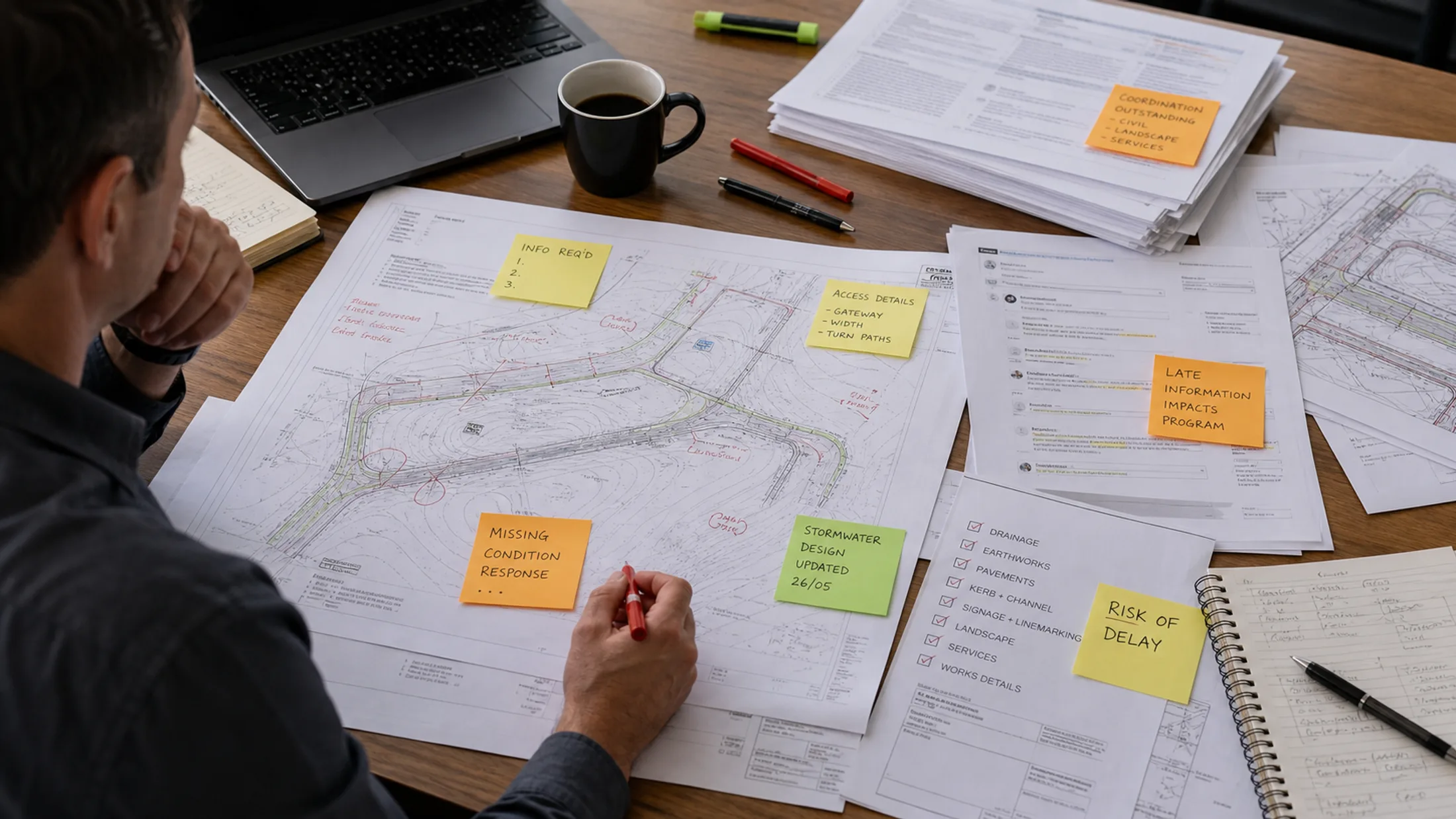
A realistic programme usually includes: site and title due diligence; survey and concept layout; planning and civil reports; application preparation and lodgement; assessment and any information request; decision notice and conditions; detailed civil and operational works design; construction and inspections; as-constructed documentation; and plan sealing or other closeout steps.
These stages can overlap, but they cannot all be compressed by asking for a faster assessment. A project may receive a decision and still be unable to start civil works because the operational works package, approvals, construction details or service coordination are not ready.
What controls the assessment period
The applicable Queensland development assessment pathway controls the formal process. Confirm the current pathway, information requirements, referral agencies and notification obligations for the specific proposal rather than applying a timeframe from another subdivision.
Application quality matters. A concept that clearly explains lot layout, access, stormwater, earthworks, services and relevant constraints gives the assessment manager a more coherent basis for review. Missing or contradictory information can lead to requests, redesign and a programme reset.
Sunshine Coast conditions also vary by site. A steep hinterland block, a flood-affected infill site, a battle-axe layout or a subdivision requiring frontage works will not have the same risk profile as a straightforward flat site with existing services.
Civil dependencies that create hidden delay
Access is often a critical dependency. Check driveway grades, sight distance, turning, crossover requirements, road frontage and construction access early. If the access geometry changes, the lot layout, retaining, drainage and building envelopes may change with it.
Stormwater is another programme driver. Confirm the lawful discharge strategy, levels, overland flow response, detention or treatment requirements, easements and downstream interface before promising a lodgement date. ‘We will solve drainage during detailed design’ is not a programme; it is a risk transfer to the future.
Services, earthworks and retaining can also affect yield and conditions. Sewer and water connections, service clashes, cut and fill, retaining near boundaries and operational works triggers may require other consultants, approvals or revised cost allowances.
A practical way to build the programme
1. Define the end point: approval only, construction-ready package, completed civil works, or sealed lots. 2. List every dependency and owner, including survey, planning, civil, geotechnical, service authorities, construction and Council milestones. 3. Mark assumptions that must be verified, such as point of discharge, service capacity, access grades and retaining limits. 4. Add a response allowance for information requests and redesign rather than presenting a best-case promise. 5. Track approval conditions separately from the application, because conditions can create new operational works, bonding, inspection or plan-sealing tasks. 6. Update the programme after each decision, not only when something goes wrong.
Mistakes that cost time and money
The biggest mistake is quoting a single end-to-end timeframe based on the statutory assessment period. That ignores design, procurement, construction and closeout. Another is lodging before the civil concept is credible, then discovering that access or drainage requires a new layout.
Developers also lose time when consultants work from different surveys or uncontrolled drawing versions. Use one current base plan and a condition register. Confirm who owns each response and what evidence is needed before the next milestone.
Finally, do not leave plan sealing until the end. As-constructed records, inspection evidence, practical completion and outstanding conditions should be tracked during construction, because recreating evidence after contractors leave is slow and expensive.
When to involve a civil engineer
Involve civil engineering before land purchase where possible, before fixing the subdivision concept, and immediately after approval if conditions affect access, stormwater, earthworks, retaining, services or operational works. The earlier review is proportionate: a feasibility screen may be enough initially, followed by detailed design once the planning pathway is clear.
CivilCity helps Sunshine Coast developers build a defensible programme around the actual civil work: site feasibility, concept layouts, access and levels, stormwater and lawful discharge, servicing, operational works documentation, construction support, as-constructed records and plan sealing closeout. Send the site address, proposed yield and target milestone for a focused programme-risk review.
FAQ
Common question
How long does a Sunshine Coast subdivision approval take?
There is no single reliable duration. The programme depends on the assessment pathway, application quality, information requests, referral requirements, conditions, civil complexity and whether operational works and plan sealing are also included in the delivery programme.
Does the council assessment period equal the whole subdivision programme?
No. The statutory assessment period is only one part. Survey, concept design, reports, lodgement, information responses, detailed civil design, operational works, construction, inspections and plan sealing can all sit before or after the decision.
What commonly delays a subdivision?
Incomplete information, unresolved access or stormwater, unclear servicing, revised layouts, referral responses, conditions that conflict with the concept, construction closeout and missing as-constructed evidence are common causes.
When should a civil engineer be involved?
Before the layout is fixed and before the approval programme is promised. Early civil input can test access, levels, stormwater, services, earthworks and operational works triggers that otherwise create redesign later.
Useful official resources
Need project-specific civil advice?
Send CivilCity the project location, approval stage and the issue you need resolved.
Contact CivilCity