
Subdivision - 24 June 2026
Battle-axe subdivision on the Sunshine Coast: access, services and stormwater risks
A practical Sunshine Coast battle-axe subdivision guide covering access handles, driveway grades, services, stormwater, easements and feasibility.
Short answer
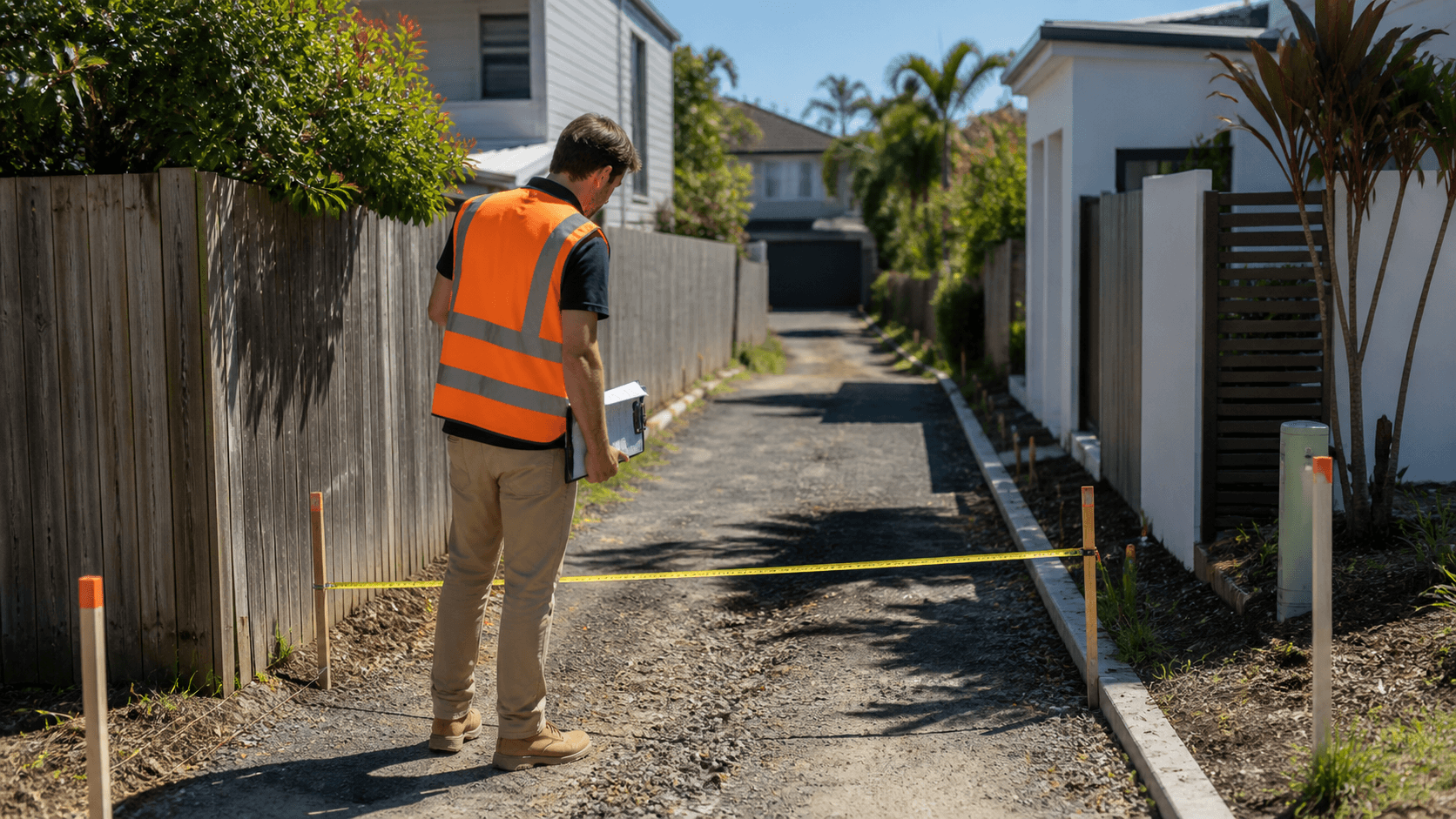
Battle-axe subdivision can work well on the Sunshine Coast, but it is easy to underestimate. The access handle is not just a driveway. It often needs to carry vehicles, services, drainage, easements and construction access.
If that narrow corridor does not work, the rear lot may not be practical.
Access is the first test
Review frontage width, driveway grade, turning space, sight distance, shared access requirements and whether vehicles can enter and exit safely. Swept paths may be needed where turning is tight.
A rear lot should not rely on awkward reverse movements or a driveway grade that becomes difficult to build or use.
Services compete for space
Sewer, water, stormwater, electrical and telecommunications services may all need to reach the rear lot. Existing services may also cross the proposed access handle.
That means the access corridor must be checked as a service corridor, not only as a traffic route.
Stormwater is often decisive
Rear lots can be difficult where stormwater needs to discharge back toward the street, through another lot or through a constrained easement. If the site slopes away from the frontage, lawful discharge needs very early attention.
This is where a simple subdivision sketch often becomes a real engineering question.
How CivilCity helps
CivilCity can test battle-axe access, servicing and stormwater feasibility before the layout advances too far.
For owners and small developers, this helps answer the question that matters most: does the rear lot actually work as a buildable, serviceable lot?
FAQ
Common question
Why is battle-axe subdivision difficult?
The access handle has to work for vehicles, services, drainage, grades, easements and future residents, often in a narrow strip of land.
What should be checked first?
Check access width, driveway grade, turning, service corridors, stormwater discharge, easements, frontage constraints and whether the rear lot can be practically serviced.
Can stormwater stop a rear lot subdivision?
It can make it difficult or expensive if there is no practical lawful discharge path or drainage corridor.
Useful official resources
Need project-specific civil advice?
Send CivilCity the project location, approval stage and the issue you need resolved.
Contact CivilCity